Monday, November 11, 2013

W. Eugene Smith

W. Eugene Smith was born on December 30, 1918 in Wichita, Kansas. Smith began his photography life by photographing for two local newspapers, the Beacon and The Wichita Eagle. From the two local newspapers to climbed his way up to Newsweek in New York City, then up to Life in 1945, during WWII. When Smith decided to leave Life he later joined Magnum photo agency in 1955.

It's hard to describe what this Nun's expression is. Is it shock? Worry? Whatever it is I really like it. It appears that she's holding a teddy bear in her hand so this leads me to think that it's something tragic.
Smith also took many photos in Japan during a Minamata outbreak and this was probably the time that this photo was taken. I like how the man in this picture is looking upwards because it looks as if he has hope that things will get better despite the present conditions.

This image is really chilling. The boy is no doubt in pain but we can't tell if he is physicaly or mentally. I have no knowledge of Minamata so I'm speaking out of ignorance, but maybe he is crying out in pain because he has Minamata maybe it is physically painful. Possibly he could have lost a loved one, regardless it really hits home for me. 

Bird's View


Focal Length29mm
Exposure1/30
F Numberf/2.8
ISO100
Focal Length20mm
Exposure1/125
F Numberf/2.8
ISO100

Focal Length29mm
Exposure1/40
F Numberf/2.8
ISO100
CameraCanon EOS 10D
Focal Length40mm
Exposure1/60
F Numberf/2.8
ISO100
CameraCanon EOS 10D
Focal Length40mm
Exposure1/40
F Numberf/2.8
ISO100
CameraCanon EOS 10D
Focal Length40mm
Exposure1/60
F Numberf/2.8
ISO100

CameraCanon EOS 10D
Focal Length40mm
Exposure1/30
F Numberf/2.8
ISO100

CameraCanon EOS 10D
Focal Length37mm
Exposure1/30
F Numberf/2.8
ISO100
Focal Length40mm
Exposure1/100
F Numberf/2.8
ISO100
Focal Length37mm
Exposure1/13
F Numberf/2.8
ISO100


Andre Kertesz


Andre Kertesz was born on July 2 1894 in Budapest, Hungary. When he got his first camera, and ICA box camera, in 1912 Kertesz proceeded to take photos of local gypsies and the surrounding Hungarian landscape. Kertesx took photos most of his life, even during WWI in the trenches. The period in which Kertesz's photos really excelled were when he moved to Paris, encouraged by his newly published magazine cover. Kertesz was  the first to have a one man exhibit and many European magazines were publishing his works.

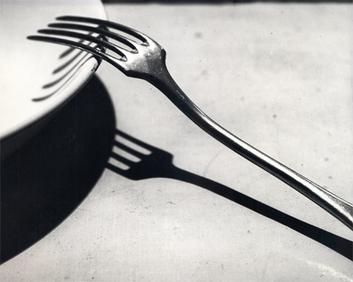
This is probably the most well known photos by Kertesz and it's obvious why. It's a stunning image and I really love the shadows of the prongs on the fork.

Kertesz had a period where he did many distortion photos similar to the one above. I really like them because they remind me of how a women's body is so distorted now a days. Women crave being skinny but most of their views are distorted by weight loss and beauty ads. 

I really like how the wall acts almost like a reflector to the ladder. The shadows almost make the image look like it's being reflected across a puddle of water or something. 

Laszlo Moholy-Nagy

Laszlo Moholy-Nagy was born in Bacsbarsod, Hungary on July 20, 1895. Before and during WWI Nagy studied law in Budapest then entered the war. After severing an injury in 1918 Nagy attended art school, Hungarian Fauve. 

I like this image, it's pretty creepy with the baby dolls. I like the criss-crossing from the fence also it adds some leading lines to the photo.

Whenever I see photos like this I always associate it with time passing and that's also what I think of when I see this image. I really like how the shot of the girl smiling is the one that's most in focus and in the rest she looks very serious. 

I really like this photo because of all the horizontal lines and I like how Nagy tilted them to give it a fresh touch. My favorite little detail is that the man at the top is actually looking down at the photographer.


Lewis Hine

Lewis H. Hine was born on September 26, 1874 in Oshkosh, Wisconsin. He did not become interested in photography until later in his life. Hine was taught botany and nature studies at the Ethical Culture School in New York and was gifted with a camera. Hine was able to bring out dark events going on in America at the time and expose them, including child labor, immigrants on Ellis Island and workers on the Empire State Building, 

Like many child labor photos, this child's expressions resemble an older man with worry strewn into his face. You can note that his clothes are in tatters and smudged with grime. 

I cannot believe how terrible the working conditions must have been for these young children, such desperate times. I believe this image was in my history book last year and they were working underground to clear a tunnel for a train, this must be true because you can see tracks in the background. Without Hine's photos we could only image what the conditions were and not actually get a glimpse from the past.

I get scared just looking at this image! I really don't understand how this was allowed, but I'm glad that Hine captured this shot. If he hadn't maybe people would still be doing jobs like this today...

Edward Weston

link
Edward Weston was born on March 24, 1886 in Highland Park, Illinois and received his first camera, a Bull's Eye 2, from his father when he was sixteen years old. As Weston's interest grew, so did his need to get a formal photo education. Weston realized this and attended Illinois College of Photography in 1908. Merely a year later Weston Weston finished the course and moved to LA where he was employed by George Steckel Portrait Studio. During this time Weston's work was noticed highly and he won many awards. The most popular of his work would probably be his photos of vegetables.

link
Weston's work with veggies are my favorites of his because he allows them to have magnificent shadows including the cabbage leaf above. You can see all the tiny veins making their way through the cabbage like a highway system or something.

link
There are many pictures of pretty shells but I find this one to be quite unique because of the angle that it's taken. It looks like a modern spaceship and is still very beautiful. I love how on each side of the shell there is a bit of symmetry and the small detailed lines are also vary cool, I like how they aren't perfect and curve.

link
Out of Weston's vegetable images I really like the pepper ones. They're so abstract and remind me of actual people because of the way the peppers curve. To me it almost looks like to people hugging :)

Walker Evans

Walker Evans was born in St. Louis, Missouri on November 3, 1903 and attended Williams College for merely a year. He dropped out to move to New York City where he fell in love with literature and intended on becoming a writer. In 1928 Evans became interested in photography and left behind literature to become a photographer. Many of Evan's photos were of during the Great Depression in America.


link
The little girls eye's are what captured my attention and drew me into this image. They look like huge doll eyes.


link
This is probably one of Evan's most memorable photos during the Great Depression. The woman's hair is greasy and it looks like she has no teeth because of the way her lips look sunken in. What I like is all the detail in this image, especially in the pattern shirt, yet it doesn't take away from the woman's eyes.


link
Here is a very similar image to the last, personally I like this one more because it has more emotion in the woman's face and she looks bored of being in the Depression, unhappiness consumes this image. 

Friday, November 8, 2013

Paul Strand

Paul Strand was born on October 16, 1890 in New York City, New York. He became interested in photography when he visited 291 Gallery run by Stieglitz and Steichen. This was a life changing moment for Strand and he realized that he wanted to be a photographer. The moment he decided this, his work was criticized by his high school photo teacher, Lewis Hine, and his later mentor Steiglitz. The criticism greatly strengthened Strand's work and he focused on Movement in the city, abstractions and street portraits.


link
This photo was taken on Wall Street and is a very iconic image. What I love about it is the building and the sidewalk that people are walking on. I think it's one of the most powerful images I've seen.


link
This is an example of Strand's more abstract work which I'm a fan of. The spokes on the wheel are my favorite part because the spaces in between allow for light to add contrast to the image.


link
I think that this is also one of Strand's most popular pieces. I really like the fence but it isn't one of my favorite photos. I like how the fence adds a lightness to the image along with the white house. 

Pre Analogous

The yellows and the greens in the sunflower add analogous but I think that the main subject of the image would be the sunflower and the sky since it's so breathtaking.

Peppers! Food would probably be a good idea for this photo challenge. I like the green and the yellow in the  peppers then next to the green is the red adding contrasting colors.


More food! As I said earlier, food would probably be the best idea to take photos because there are so many analogous colors in them. 

Thursday, November 7, 2013

Pre- Bird's Eye

This image was really small, so it isn't the best quality but I still really like it. The neck of the guitar leads the viewer to the man's face and I think it's really great how he's looking up into the camera. I think I'm going to play with leading lines in this assignment because images that are far away are pretty much out of my comfort zone. 

This image is just great, all of the people splashing around in the pool make everything look really cool. The color of the people's skin also contrasts with the very blue water which makes the people stand out in all the splashing.
Sports photos to me are kind of boring but the bird's eye view above the basket makes a really interesting view. The man reaching out for the ball and the two circles (the hoop and the basketball) are really fun details in the photo.